
Deeplabv3

import torch
model = torch.hub.load('pytorch/vision:v0.10.0', 'deeplabv3_resnet50', pretrained=True)
# or any of these variants
# model = torch.hub.load('pytorch/vision:v0.10.0', 'deeplabv3_resnet101', pretrained=True)
# model = torch.hub.load('pytorch/vision:v0.10.0', 'deeplabv3_mobilenet_v3_large', pretrained=True)
model.eval()
所有預訓練模型都期望輸入影像以相同方式進行歸一化,即形狀為 (N, 3, H, W) 的 3 通道 RGB 影像的小批次,其中 N 是影像數量,H 和 W 預期至少為 224 畫素。影像必須載入到 [0, 1] 範圍內,然後使用 mean = [0.485, 0.456, 0.406] 和 std = [0.229, 0.224, 0.225] 進行歸一化。
該模型返回一個 OrderedDict,其中包含兩個張量,它們與輸入張量具有相同的高度和寬度,但有 21 個類別。output['out'] 包含語義掩碼,output['aux'] 包含每個畫素的輔助損失值。在推理模式下,output['aux'] 沒有用處。因此,output['out'] 的形狀為 (N, 21, H, W)。更多文件可在此處找到。
# Download an example image from the pytorch website
import urllib
url, filename = ("https://github.com/pytorch/hub/raw/master/images/deeplab1.png", "deeplab1.png")
try: urllib.URLopener().retrieve(url, filename)
except: urllib.request.urlretrieve(url, filename)
# sample execution (requires torchvision)
from PIL import Image
from torchvision import transforms
input_image = Image.open(filename)
input_image = input_image.convert("RGB")
preprocess = transforms.Compose([
    transforms.ToTensor(),
    transforms.Normalize(mean=[0.485, 0.456, 0.406], std=[0.229, 0.224, 0.225]),
])

input_tensor = preprocess(input_image)
input_batch = input_tensor.unsqueeze(0) # create a mini-batch as expected by the model

# move the input and model to GPU for speed if available
if torch.cuda.is_available():
    input_batch = input_batch.to('cuda')
    model.to('cuda')

with torch.no_grad():
    output = model(input_batch)['out'][0]
output_predictions = output.argmax(0)
此處的輸出形狀為 (21, H, W),在每個位置都有未歸一化的機率,對應於每個類別的預測。要獲取每個類別的最大預測,然後將其用於下游任務,您可以執行 output_predictions = output.argmax(0)。
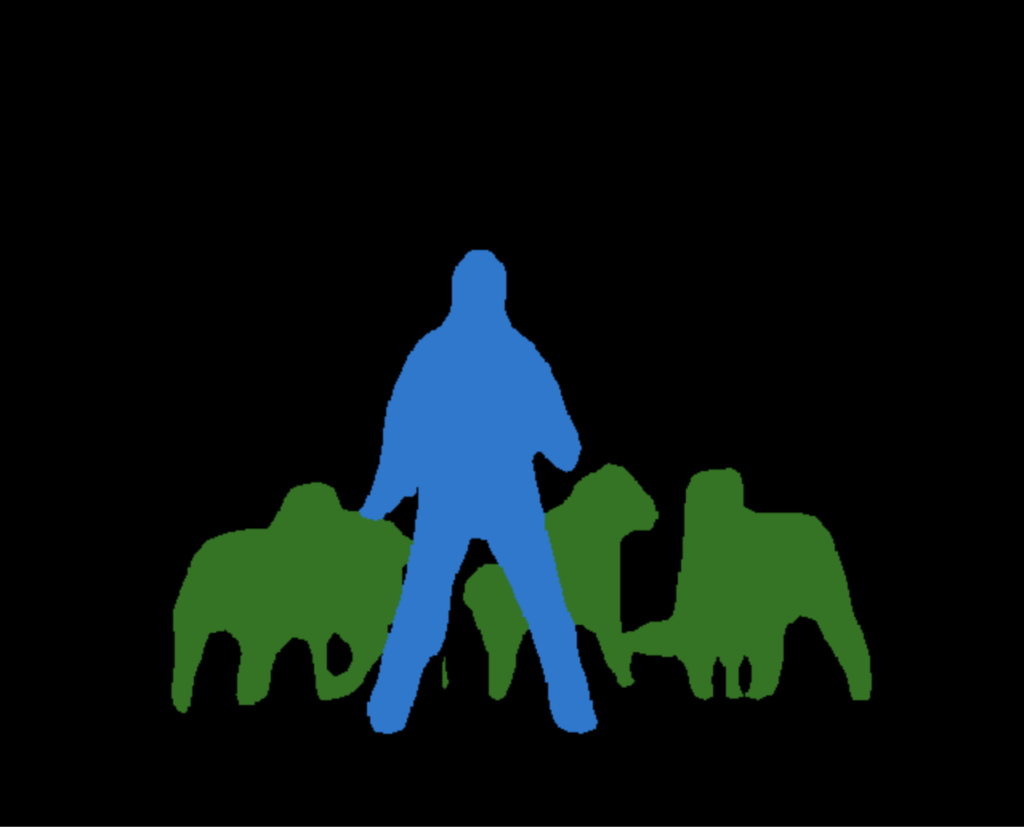
這是一個小片段,用於繪製預測圖,其中每個顏色分配給每個類別(請參見左側的視覺化影像)。
# create a color pallette, selecting a color for each class
palette = torch.tensor([2 ** 25 - 1, 2 ** 15 - 1, 2 ** 21 - 1])
colors = torch.as_tensor([i for i in range(21)])[:, None] * palette
colors = (colors % 255).numpy().astype("uint8")

# plot the semantic segmentation predictions of 21 classes in each color
r = Image.fromarray(output_predictions.byte().cpu().numpy()).resize(input_image.size)
r.putpalette(colors)

import matplotlib.pyplot as plt
plt.imshow(r)
# plt.show()
模型描述
Deeplabv3-ResNet 是由使用 ResNet-50 或 ResNet-101 主幹的 Deeplabv3 模型構建的。Deeplabv3-MobileNetV3-Large 是由使用 MobileNetV3 large 主幹的 Deeplabv3 模型構建的。預訓練模型已在 COCO train2017 的子集上進行訓練,涵蓋 Pascal VOC 資料集中存在的 20 個類別。
在 COCO val2017 資料集上評估的預訓練模型的準確性如下所示。
| 模型結構 | 平均 IOU | 全域性畫素級準確性 |
|---|---|---|
| deeplabv3_resnet50 | 66.4 | 92.4 |
| deeplabv3_resnet101 | 67.4 | 92.4 |
| deeplabv3_mobilenet_v3_large | 60.3 | 91.2 |
資源
