
HarDNet

import torch
model = torch.hub.load('PingoLH/Pytorch-HarDNet', 'hardnet68', pretrained=True)
# or any of these variants
# model = torch.hub.load('PingoLH/Pytorch-HarDNet', 'hardnet85', pretrained=True)
# model = torch.hub.load('PingoLH/Pytorch-HarDNet', 'hardnet68ds', pretrained=True)
# model = torch.hub.load('PingoLH/Pytorch-HarDNet', 'hardnet39ds', pretrained=True)
model.eval()
所有預訓練模型都要求輸入影像以相同的方式進行歸一化,即由形狀為 (3 x H x W) 的 3 通道 RGB 影像組成的小批次資料,其中 H 和 W 預計至少為 224。影像必須載入到 [0, 1] 範圍內,然後使用 mean = [0.485, 0.456, 0.406] 和 std = [0.229, 0.224, 0.225] 進行歸一化。
這是一個示例執行。
# Download an example image from the pytorch website
import urllib
url, filename = ("https://github.com/pytorch/hub/raw/master/images/dog.jpg", "dog.jpg")
try: urllib.URLopener().retrieve(url, filename)
except: urllib.request.urlretrieve(url, filename)
# sample execution (requires torchvision)
from PIL import Image
from torchvision import transforms
input_image = Image.open(filename)
preprocess = transforms.Compose([
    transforms.Resize(256),
    transforms.CenterCrop(224),
    transforms.ToTensor(),
    transforms.Normalize(mean=[0.485, 0.456, 0.406], std=[0.229, 0.224, 0.225]),
])
input_tensor = preprocess(input_image)
input_batch = input_tensor.unsqueeze(0) # create a mini-batch as expected by the model

# move the input and model to GPU for speed if available
if torch.cuda.is_available():
    input_batch = input_batch.to('cuda')
    model.to('cuda')

with torch.no_grad():
    output = model(input_batch)
# Tensor of shape 1000, with confidence scores over ImageNet's 1000 classes
print(output[0])
# The output has unnormalized scores. To get probabilities, you can run a softmax on it.
probabilities = torch.nn.functional.softmax(output[0], dim=0)
print(probabilities)
# Download ImageNet labels
!wget https://raw.githubusercontent.com/pytorch/hub/master/imagenet_classes.txt
# Read the categories
with open("imagenet_classes.txt", "r") as f:
    categories = [s.strip() for s in f.readlines()]
# Show top categories per image
top5_prob, top5_catid = torch.topk(probabilities, 5)
for i in range(top5_prob.size(0)):
    print(categories[top5_catid[i]], top5_prob[i].item())
模型描述
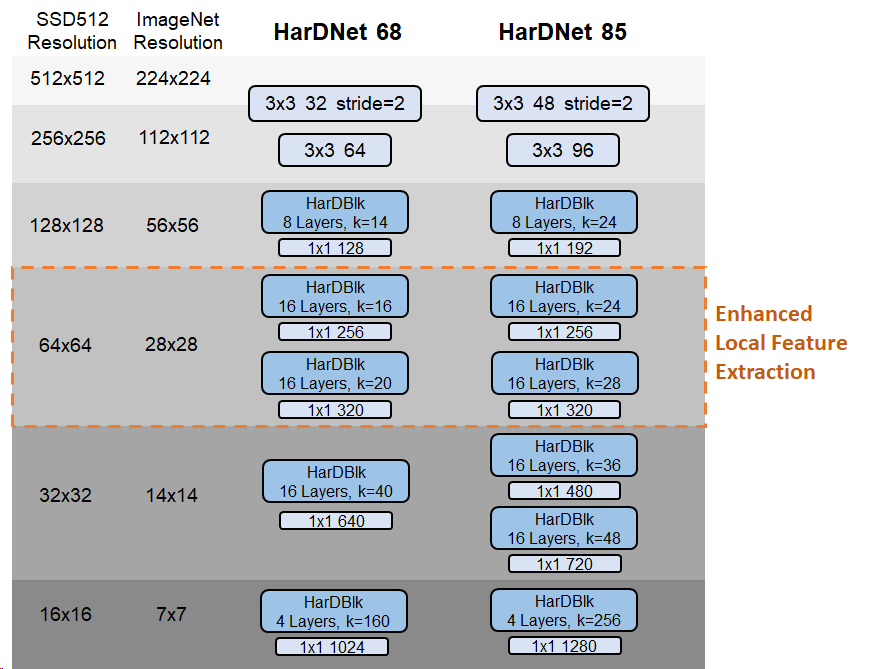
Harmonic DenseNet (HarDNet) 是一種低記憶體流量的 CNN 模型,它快速高效。其基本概念是同時最小化計算成本和記憶體訪問成本,因此 HarDNet 模型在 GPU 上執行的速度比具有相同準確度的 ResNet 模型快 35%(除了為與 MobileNet 比較而設計的兩個 DS 模型)。
這裡有 4 種版本的 hardnet 模型,分別包含 39、68、85 層,帶或不帶深度可分離卷積。它們在 ImageNet 資料集上使用預訓練模型進行單裁剪(1-crop)的錯誤率如下所示。
| 模型結構 | Top-1 錯誤率 | Top-5 錯誤率 |
|---|---|---|
| hardnet39ds | 27.92 | 9.57 |
| hardnet68ds | 25.71 | 8.13 |
| hardnet68 | 23.52 | 6.99 |
| hardnet85 | 21.96 | 6.11 |
參考文獻
